
TRUST Safeguarding Policy
Policy Aims
Tele-Rehab Ltd has a commitment to ensure that all their own staff and associates have a clear understanding of what constitutes the abuse of adults at risk. The Health and Social Care Act 2008 sets outcomes (Regulation 13) for all CQC registered services, giving them a responsibility to safeguard all adults who use services from abuse and improper treatment.
Tele-Rehab Ltd believes that everyone has the basic human right to live a life based on fairness, respect, equality, dignity, and autonomy and we aim to promote these values throughout our work.
An adult at risk is defined as a person aged 18 or over…..
“ …. who is, or may be, in need of care services by reason of mental or other disability, age or illness, and who is, or may be unable to take care of him or herself, or unable to protect him or herself against significant harm or exploitation” (Care Act 2014).’
Tele-Rehab Ltd only communicates with their patients remotely carrying out tele-consultations.
Tele-Rehab Ltd feels it is important for all staff to be aware of the information within this policy as part of their training.
Safeguarding Lead
This policy lies at the heart of Tele-Rehab Ltd and is integral to our aims, ethos and values. The Safeguarding Lead for Tele-Rehab Ltd is Mrs Sue Paddison, Director.
Email: sue.paddison@trusttelerehab.com
Local Authority Information
Wiltshire Council T: 0300 456 0111
Monday to Thursday between 8.30am and 5.20pm (Friday 4.20pm)
Out of hours calls will be answered by the Emergency Duty Service on 0300 456 1000
Online to report a safeguarding concern – https://adultslas.wiltshire.gov.uk/web/portal/pages/referrals/safeguarding
In emergency call 999 for the police.
Contact the CQC on 03000 616161.
This policy will be provided to all staff members and clients for information.
Legal and Statutory Guidance Framework for this Policy
- Care Act 2014
- Care & Support Statutory Guidance, issued under the Care Act 2014
- Human Rights Act 1998
- Equalities Act 2010
- Health and Social Care Act 2008 (Regulated Activities) Regulations 2014 (Part 3) (as amended)
- Mental Capacity Act 2005 and Deprivation of Liberty Safeguards 2017
- Domestic Abuse Act 2021
- Health and Care Act 2022
This policy is central to Tele-Rehab Ltd’s CQC Registration and Compliance and is reflected in all the CQC Single Assessment Framework Quality Statements.
Policy and Procedure
Abuse may be a one-off incident, or a series of incidents over a period of time. Sometimes this may be intentional, or due to poor practice and unsafe ways of working which puts the client at risk.
To understand how to protect adults at risk, all staff need to be aware of how different forms of abuse can manifest and accept the fact that anyone can be an abuser.
There are many possible forms of abuse, the most common risks for our clients include:
Physical – includes hitting; slapping; pushing; pinching; burning; manual handling in a harsh manner; misuse of medication or use of inappropriate sanctions and improper restraint.
Sexual – including sexual acts to which a vulnerable adult has not consented; could not consent or was pressurised into committing and can be either contact or non-contact.
Psychological – including emotional abuse; verbal abuse; threats of harm; deprivation; humiliation; controlling; withdrawal of support needs or threats to withdraw support.
Financial or Material – including theft; fraud; exploitation; pressure in connection with wills; misuse of property or possessions.
Neglect or Acts of Omission – including ignoring medical, physical or emotional needs; failure to provide access to appropriate health, social or educational services; the withholding of the necessities of life such as medication, adequate heating and nutrition.
Discriminatory – includes racist or sexual abuse; abuse based on the person’s disability,
age or any other form of harassment, slurs, or similar treatments.
County Lines and Cuckooing – vulnerable people being targeted by gangs and made to participate in criminal activities, usually by the use of threats and coercion. This may involve the gangs using the client’s own home for criminal activities.
Modern Slavery – people at risk of being exploited, forced to work through the threat of violence and restrictions placed on their freedoms. Concerns regarding Modern Slavery must be reported in the same manner as any other safeguarding concerns and will normally be referred in additionally via the Modern Slavery referral mechanism.
Prevent Statutory Duty – Radicalisation and Counterterrorism
Radicalisation is a psychological process where vulnerable individuals are groomed to engage into criminal and/or terrorist activity. Concerns of radicalisation must be reported in the same manner as any other safeguarding concerns and will normally be referred, in addition, via the PREVENT / Channel Mechanism.
Hate Crime
A crime, typically involving violence, threats of violence or verbal abuse, that is motivated by prejudice on the basis of ethnicity, disability, religion, sexual orientation, or similar grounds.
Forced Marriage
Where one person is forced into marriage either against their will or because they are unable to consent. Forced marriage is when you face physical pressure to marry (for example, threats, physical violence or sexual violence) or emotional and psychological pressure (e.g. if you are made to feel like you are bringing shame on your family).
Predatory Marriage
Similar to forced marriage, under current legislation, where one person lacks the capacity to consent to the marriage and it is entered into for the benefit (often financial) of one party.
RESPONDING TO ABUSE
It is the responsibility of all staff working directly or indirectly for Tele-Rehab Ltd to report suspected, alleged or actual abuse or neglect, regardless of whether or not this relates to abuse, or neglect being directed at a client by:
• Another client
• A member of staff (regardless of their position)
• A relative/friend /associate
• Any other person/s
Reporting Abuse
Any member of staff who knows of or believes that abuse of an adult at risk is occurring has an obligation to report it as quickly as possible to the Tele-Rehab Ltd’s safeguarding lead / directors, or direct to the Police or appropriate local Social Care Adult Safeguarding Team / Contact team. Failure to report abuse could be seen as collusion and may be subject to disciplinary proceedings.
Tele-Rehab Ltd recognises that it is not always easy to make allegations of abuse, however the well-being of your client must remain paramount.
CONSENT
Consent is a vital consideration.
In general, the adult victims of abuse do not have to act against their abuser and have a right not to do so. Independent associates of Tele-Rehab Ltd are responsible for highlighting the need for an assessment of capacity via the patient’s General Practitioner or the social worker and share their concerns with the directors of the company.
Confidentiality and Data Protection
In view of the sensitive and confidential nature of our work and the information that we collect and hold about our clients and other stakeholders, this policy must be read alongside Tele-Rehab Ltd’s policies on UK GDPR. Concerns about data protection should not prevent the sharing of information for the purposes of safeguarding.
Action in Emergency Situations
If the situation is an emergency, with an adult in immediate danger, the individual who observes this must take urgent action to intervene assist the person to a place of safety and call 999 for emergency assistance as soon as possible. They should give any necessary first aid (within their capabilities) and contact appropriate emergency services. If the abuser remains present, staff should seek to calm the situation. It is however important to remember that staff have a right to avoid placing themselves at risk of violence or other harm. Every effort should be made not to interfere with any evidence or question those present as this may compromise any criminal investigation.
Guidance on the Reporting of alleged Incidents of Abuse or Poor Practice
To observe the principles of good practice, written records must include the following:
• What happened? Report facts, direct observations, and actual conversations only.
• Where did it happen? State the location and approximate time of the incident.
• When did it happen? State the date and approximate time of the incident
• Who was present? State the names/contact details of any witnesses (e.g. colleague, family member or member of the public)
Do’s and Don’ts:
• Do use plain language not jargon
• Do use legible handwriting or digital documents
• Do Tele-Rehab Ltd’s Incident / Accident Report form
• Do not give opinions or judgements
Team members should write a clear, objective account of any incident of abuse they witness and share this with their supervisor as soon as possible.
CQC Statutory Notifications
Incidents will be reported and made available to the Care Quality Commission (CQC) within the necessary timescales as required. There are clear guidelines under their statutory notification process; this will normally be done by the Registered Manager. Copies should be retained of all such notifications.
Ongoing Co–Operation with Statutory Services in Adult Safeguarding Investigations and Processes.
Tele-Rehab Ltd will work in partnership with the General Practitioner and statutory services on how to ensure safeguarding adults using Tele-rehab services. Ensure the ongoing safeguarding of any adult referred. This should be done in an open and transparent way. There may need to be a liaison with a commissioner of Tele-Rehab Ltd where the service is not purchased directly by the client.
Where referrals are made to the statutory services it is important that Tele-Rehab Ltd make regular follow ups to ensure that they are aware of any ongoing involvement from statutory services and the outcome.
Interagency collaboration and partnership is a key principle of the Care Act 2014 and other related legislation and guidance.
Action to be taken in the Absence of a Statutory Investigation
In instances where an investigation by the Social Services and/or Police against an associate of Tele-Rehab Ltd member does not proceed or is inconclusive, liaison should take place with the Director(s) as to how they wish to proceed. This may then lead to an internal investigation. All involved should keep the situation under review in case it becomes possible or necessary to re-refer to statutory services. Tele-Rehab Ltd will follow statutory obligations to report such incidents to the CQC and, as necessary, staff to the Disclosure and Barring Service as per current government guidance/procedures.
Additional Procedural Issues
Tele-Rehab Ltd will comply with the Health and Social Care Act 2008 requirements to protect all clients from abuse, exploitation, and neglect and self-harm by ensuring that:
• All new employees / associates submit personal details to complete an Enhanced DBS check.
• All new employees / associates will, prior to employment, provide a full employment history, photographic ID and satisfy us as to their fitness to work with adults at risk.
• A session on the protection of adults is included in the induction programme for all staff / associates, training will be updated regularly according to national guidance.
• All staff members have access to a supply of Incident / Accident notification forms.
• All Managers are aware that they have a duty to reinforce protection issues during team meetings and individual supervision sessions.
• Staff competence and understanding of their client’s safeguarding risks will be
reviewed at least annually.
Referral to the Disclosure and Barring Service / professional Bodies
Where the incident has been perpetrated by a member of Tele-Rehab Ltd or engaged through Tele-Rehab Ltd consideration will need to be given at the conclusion of the investigation of whether this meets the threshold to make a referral to the Scheme – this is
Dealing with Restraint
Tele-Rehab Ltd are a remote tele-consultation company, whereby no interaction physically happens with patients. As a company, we feel providing our staff this information is good for training purposes.
The policy is to limit the use of restrictive physical intervention to situations where it is absolutely necessary, such as preventing injury to the adult individual and others.
Restrictive physical intervention is only one technique in a range of possible responses to threatening or actual violent behaviour. It must therefore only be used when other methods, not involving the use of force, are unlikely to achieve the desired outcome.
Restrictive physical intervention must be used as little as possible, always as a last resort, the minimum force necessary used to prevent injury or serious damage and employed for the shortest duration.
Prolonged or excessive use of Restrictive Physical Intervention may amount to a restriction or
deprivation of liberty and a child being in “secure accommodation”.
The application of all forms of corporal punishment (i.e. physical punishment, including pushing, cuffing, striking etc) and any intentional application of physical force used as a punishment are prohibited and unlawful. Restrictive physical intervention must not be used to simply secure compliance with staff instructions.
Every episode of restrictive physical intervention must be fully documented.
Staff will respect adults and build good relationships in a safe and calm atmosphere, enhanced by a policy of positive reinforcement for good behaviour. Whilst the staff member will on occasions have to make instant but measured decisions, time to assess situations and consult with colleagues will enhance decision-making.
The issue of restrictive physical intervention raises difficult decisions for professionals and it is important that this procedure is followed. If professionals believe inappropriate restrictive physical intervention has taken place they must report this to a senior manager and a referral made to the Local Authority Designated Officer LADO contact within 1 working day.
The LADO for Wiltshire council can be contacted by email: LADO@wiltshire.gov.uk Or Call 0300 456 0108 (Option 6).
All incidents of alleged or suspected inappropriate restrictive physical intervention will be investigated according to safeguarding procedures.
Auditing and Monitoring
Tele-Rehab Ltd will set up regular auditing and governance systems to ensure that this policy is adhered to and that any safeguarding incident events are shared with others in Tele-Rehab Ltd and where necessary lessons are learnt from such.
This might include:
• Collation and review of CQC Statutory Notifications
• Collation and review of Complaints and Concerns which may well contain safeguarding elements.
• Regular review and auditing of any safeguarding concerns raised, and actions taken
• Due diligence regarding quality of training and regular evaluation of training provided and added value from such.
How we will work with stakeholders to ensure we meet this policy
Tele-Rehab Ltd is committed to working openly and transparently with all stakeholders when it comes to the protection and safeguarding of adults, hence why this policy is available to all those who engage with our service.
This policy needs to be shared with the people outlined below and those individuals / stakeholders who use our service.
This policy will be given to all staff who are employed by, or are associates of, Tele-Rehab Ltd, at the commencement of their induction. They will be asked to confirm receipt and to confirm that they have read and understood the content.
How allegations against the Registered Manager are to be reported
We are committed to maintaining a transparent and safe environment for all staff and clients. It is vital that any concerns or allegations relating to the conduct of the Registered Manager are reported promptly and investigated thoroughly.
To prevent a closed culture and reduce the risk of harm:
• All associates/ staff, clients and other professionals must feel confident and supported to raise concerns or allegations about the Registered Manager without fear of reprisal or victimisation.
• Concerns can be raised through other senior leadership members in the company or via our whistleblowing policy.
• We will ensure that any allegation against the Registered Manager is taken seriously, treated with sensitivity and impartiality, and investigated according to safeguarding procedures and regulatory requirements.
• Where appropriate, external agencies such as the Local Authority Designated Officer (LADO) will be informed immediately to oversee the referral and investigation of allegations against staff in positions of authority.
• The company guarantees protection and support to anyone raising concerns, fostering a culture of openness and accountability essential for safeguarding.
The LADO for Wiltshire council can be contacted by email: LADO@wiltshire.gov.uk Or Call 0300 456 0108 (Option 6).
By providing clear reporting routes and assurances of thorough investigation, we aim to ensure that no safeguarding concerns remain unreported or unaddressed, thereby protecting all children and adults using our services.
Training Requirements
The training needs of all associate/staff working with Tele-Rehab Ltd will be reviewed as part of their Induction. Prior learning (where a certificate can be provided) may be considered. Whatever the level of prior training, all staff must be given access to this policy and must sign to say it has been read and understood.
See the Safeguarding Procedure below.
Safeguarding Procedure
The Four Stage Process
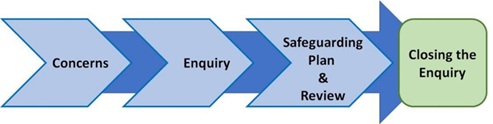
Stage 1: Concerns
Immediate action in cases of emergency. Response within one working day.
Stage 2: Enquiries
Initial conversation – same day concern is received if not already taken place.
The Tele-Rehab team will refer to the safeguarding statutory services in the area of the client domain and to the general practitioner.
Stage 3: Safeguarding Plan and Review
Where a safeguarding plan put in place following receipt of investigation report, Tele-Rehab staff will follow the proposed plan.
Review – as stated within the investigation report, set by the local authority policies and procedures.
Stage 4: Closing the enquiry
As stated within the investigation report.
This is the procedure to be followed:
This procedure must be read in conjunction with the service’s Safeguarding Policy, which includes relevant legislation relating to safeguarding and some of which is within the Care Act 2014.
1 PREVENTING ABUSE
1.1 Tele-rehab Ltd are committed to maximising the client’s choice, control and inclusion and protecting their human rights as important ways of meeting their individual needs and reducing the potential for abuse.
1.2 Directors and associates are expected to be aware through their own formal mandatory trainings of discrimination, which might amount to discriminatory abuse or cause psychological harm? This includes discrimination on the grounds of age, disability, gender, gender identity, race, religion, belief or sexual orientation.
1.3 Directors and associates are expected to be aware through their own formal mandatory trainings of their individual responsibilities to prevent, identify and report abuse when providing care and treatment. This includes referral to other providers.
1.4 Directors and associates are expected to be aware through their own formal mandatory trainings of the impact that diversity, beliefs and values of people who use services can have.
1.5 As part of the recruitment policy, every applicant for a job should complete a Rehabilitation of Offenders Declaration Form, DC-043, in which they must declare any offence for which they have been convicted, regardless of time lapsed, or offences otherwise regarded as spent. This also includes applicants being the subject to a Disclosure and Barring Service check.
1.6 Directors and associates are expected to be aware through their own formal mandatory trainings of their personal responsibility to safeguarding clients; AND are aware of the guidance on Recognising and Understanding Abuse, DC-021, and associated procedures. This must include an understanding of the Local Safeguarding Board adult/child protection and safeguarding policies and procedures and other organisations who may be involved in responding to suspected abuse appropriate to their role.
1.7 Directors and associates are expected to be aware through their own formal mandatory trainings of the different forms of abuse and be equipped to recognise the signs of abuse that may have taken place. This includes a lack of dignity and respect which can cause psychological harm.
1.8 Directors and associates are expected to be aware through their own formal mandatory trainings of the risk factors for abuse and what they must do if a person is being abused, suspected of being abused, is at risk of abuse or has been abused.
1.9 Where required, the service will work in partnership with other relevant bodies to contribute to other individual risk assessments, developing plans for safeguarding adults at risk. Including, implementing and regular reviewing outcomes for clients.
1.10 Tele rehab Ltd will ensure that safeguarding policy and procedures are available online to their associates.
1.11 the Directors of Tele-Rehab Ltd should monitor and review incidents, concerns and complaints that have the potential to become an abuse or safeguarding concern and take appropriate action to prevent them.
1.12 The Directors of Tele-Rehab ltd make it known that he/she is always available to discuss any concerns that people may have about the service and takes appropriate action to deal with them.
1.13 Information is provided to people who use the service on how to raise a complaint or any concerns they may have about care of the clients.
2 SAFEGUARDING PRINCIPLES
2.1 The following six principles apply to all staff who provide services to those whose circumstances put them at risk. These principles should inform the ways in which you work. These six key principles underpin all adult safeguarding work:
Empowerment – People being supported and encouraged to make their own decisions and informed consent.
Prevention – It is better to act before harm occurs. Clients receive clear and simple information about what abuse is, how to recognise the signs and what they can do to seek help.
Proportionality – The least intrusive response appropriate to the risk presented. Staff work in my interest, and they will only get involved as much as needed.
Protection – Support and representation for those in greatest need. Clients get help and support to report abuse and neglect. Clients get help so that I can take part in the safeguarding process to the extent to which they want to.
Partnership – local solutions through services working with their communities. Communities have a part to play in preventing, detecting and reporting neglect and abuse. Staff ensure that any clients personal and sensitive information is kept in confidence, only sharing what is helpful and necessary.
Accountability and transparency in delivering safeguarding. Clients understand the role of everyone involved in their life and so do those who provide the service.
3 DEALING WITH SUSPECTED OR REPORTED ABUSE
DIRECTORS AND ASSOCIATES ARE EXPECTED TO BE aware THROUGH THEIR OWN
FORMAL MANDATORY TRAININGS OF THE PROCESS to follow the local Safeguarding Board Adults Policies and Procedures.
3.1 Where a member of staff recognises the signs or suspects abuse of a clients it should be reported to the manager without delay.
3.2 The manager or senior person on duty must act immediately to ensure that any abuse identified is stopped and suspected abuse is addressed by:
• Separating the alleged abuser from the person who uses services and others who may be at risk or managing the risk by removing the opportunity for abuse to occur, where this is within the control of the provider.
• The manager (or other authorised person) should report the allegation to the Social Service Safeguarding Team and follow Local Safeguarding Board Adults Policies and Procedures. This will involve reporting the matter to the local authority who will have multi-agency arrangements in place for adult/child protection referrals. In some circumstances, it may be appropriate to also report directly to the police. The incident should be notified to CQC following the CQC Statutory Notifications procedure, MA-16.
• Follow the Local Safeguarding Board Adults/Children Policies and Procedures for reporting and investigating abuse.
• Follow the referral process and timescales as described in all relevant local and national multi-agency procedures when responding to suspected abuse. They will take account of circumstances of the person using the service to identify and respond appropriately to other potential risk of abuse.
• Follow the protection plan agreed through the multi-agency procedures in order to reduce the risk of further abuse after an actual or suspected case of abuse.
• Inform clients representatives of the alleged abuse and the actions that have been taken.
• Set up a confidential file and keep a recorded description of the incident and date and time the matter was reported to safeguarding authorities and CQC.
• Contribute to actions required including sharing information and attending forums.
• Work collaboratively with all relevant services, teams and agencies to safeguard and protect the welfare of clients and during any investigation process.
3.3 Tele-Rehab Ltd clinicians (or other authorised person) must ensure that every effort is made to protect the privacy of the client by maintaining confidentiality, referring to Confidentiality and Access to Records.
3.4 Directors of Tele-Rehab Ltd should ensure that arrangements are put in place that enables staff and clients affected by the incident to access counselling services if required.
4 CONSENT DURING A SAFEGUARDING ALLEGATION AND SUBSEQUENT INVESTIGATION.
TELE-REHAB LTD DOES NOT OFFER CLINICAL SERVICES TO CHILDREN.
THIS INFORMATION IS PROVIDED FOR A SITUATION WHERE A CHILD IS OBSERVED IN THE BACKGROUND DURING A VIDEO CONSULTATION OF AN ADULT CLIENT.
When safeguarding children in England, consent from the child or their parents is not required to initiate or conduct a safeguarding referral or investigation if there is concern about a child’s welfare. The statutory guidance (including Working Together to Safeguard Children) and other authoritative sources support the following approach:
• Independent of Consent: Professionals must take action to safeguard a child whenever there are concerns, regardless of whether the parent or carer consents to information sharing or an investigation. This is because the child’s right to protection from harm overrides requirements for consent.
• Good Practice to Inform: While consent is not needed for a safeguarding referral or investigation, it is considered good practice to inform parents/carers about the concerns and what steps are being taken unless doing so would place the child or others at further risk.
• Child’s Voice and Wishes: Social workers must, as far as possible, involve the child in the process, seeking their views and wishes in an age-appropriate manner. However, parents cannot prevent professionals from seeing or interviewing their child if there are safeguarding concerns. If a parent refuses access, children’s services can escalate the matter, including seeking a court order if necessary.
• Information Sharing: Information can be shared between agencies and professionals without parental consent if it is necessary for safeguarding a child. The law (including the Children Act 1989 and UK GDPR) recognises that safeguarding is a compelling reason to override confidentiality and share information as needed to protect the child.
• Best Interests and Proportionality: Any intervention should be proportionate and focused on the best interests of the child, involving only those necessary and sharing only the information needed for safeguarding. All actions and the rationale should be clearly documented.
5 MAINTAINING CLIENT’S HEALTH AND WELLBEING
Following an incident of alleged abuse, the client will be comforted and a review of the person- centred care plan carried out to ensure they are appropriately supported.
6 PROVIDING SUPPORT TO PEOPLE WHO REPORT ABUSE
6.1 When people report abuse, the Directors must ensure that they are taken seriously, treated with dignity and respect and provided with appropriate help.
6.2 The Directors must ensure that clients are supported when they make allegations of discrimination or experience discrimination. Staff must not unlawfully victimise people who use services for making a complaint about discrimination.
6.3 When allegations of discrimination are substantiated, the Directors must take corrective action and make changes to prevent it happening again. This may involve seeking specialist advice or support.
6.4 People should be supported to take part in the safeguarding process to the extent to which they want or are able to, or to which the process allows and are kept informed of progress.
6.5 The Directors should ensure that people are made aware of, and supported to access, sources of support outside the service including local independent information advice, independent mental capacity advocacy services or independent mental health advocacy services where relevant.
6.6 The Directors ensures that people are provided with support or given information about how they can obtain support, for as long as they need it.
6.7 The Directors promotes a culture where people feel reassured that their care, treatment and support will not be compromised if they raise issues of abuse.
7 PROVIDING INFORMATION TO CLIENTS AND THEIR REPRESENTATIVES
7.1 The DIRECTORS should make client’s, advocates, those acting on their behalf and staff
aware of this procedure and provide information to people about:
• What abuse is and how to recognise the signs.
• What they should do if they or another person are being abused or suspect abuse, including relevant contact details under the Local Safeguarding Board Adults/Children Policies and Procedures.
• What they might expect to happen when a referral is made to the Social Service Safeguarding Team under the Local Safeguarding Board Adults/Children Policies and Procedures.
• How information about a safeguarding concern is appropriately shared in line with multi- agency procedures, taking into account the sensitive nature of the information.
• Information that reassures people that safeguarding procedures are delivered in a way that protects people’s human rights, including their human right to life and not to be treated in an inhuman or degrading way.
• Information that assures people that staff who are required to use restrictive physical interventions have received specialist training.
7.2 The Directors should ensure that staff are kept up to date about changes to national and Local Safeguarding Board Adults/Children arrangements.
8 ABUSE OF STAFF BY CLIENTS
8.1 If a client is suspected of allegedly abusing a member of staff, the DIRECTORS should:
• Establish with the Associate member what form the alleged abuse has taken place.
• Suspend further appointments with the client by the staff/associate member pending investigation of the alleged abuse.
• Take statements from the staff/associate member and any witnesses.
• Ask the member of staff/associate to complete an Accident / Incident / Near Miss Report.
• The Directors should arrange a visit with the client to discuss the matter and the reason for the incident.
• Make arrangements for another care worker to visit where appropriate.
• Talk to the family of the alleged abuser.
• If founded, carry out a risk assessment before the service is reintroduced.
• Make arrangements for a best interest meeting where appropriate
• Provide support to the member of staff and take any required actions in relation to the incident.
• Contact the Care Quality Commission.
• Contact the police (if appropriate).
• Inform the Social Service Safeguarding Team.
• Inform the clinical Manager.
• In discussion with all stakeholders, consider if the risk requires withdrawal of the service.
• Complete the necessary documentation as in section 16.0.
9 IMPROVEMENT ACTIONS FOLLOWING INCIDENT OF ABUSE
9.1 When allegations of abuse are made, the investigations and the corrective actions taken are recorded. Where changes in practice are required as a result, procedures are reviewed and amended to prevent recurrence.
9.2 Information gained from safeguarding concerns will also be used by the Directors to identify any non-compliance, or any risk of non-compliance, with the regulations and to decide what will be done to return to compliance.
9.3 Where allegations of abuse are substantiated, the Directors must take action to redress the abuse and take the necessary steps to ensure the abuse is not repeated. This may involve seeking specialist advice or support.
9.4 The Directors will continue to monitor the situation following the incident of abuse to reassure the client and prevent further abuse.
10 REPORTING ALLEGATIONS OF ABUSE
10.1 All allegations of abuse must be reported to the Social Service Safeguarding Team and a record kept by the Registered Manager of the date when the allegation was reported.
10.2 Where staff/associates are reasonably suspected to have caused harm or risk of harm to clients, and this includes the requirement for the person to be referred to the Disclosure and Barring Service, they must be referred for inclusion on the Disclosure and Barring Service Register where the requirements for referral are met.
10.3 If bad practice involves a criminal or illegal act such as assault or sexual abuse, the manager must report the matter to the police immediately. A strategy plan would be put in place to protect any individual clients or staff involved and fully documented to inform staff of their responsibilities.
11 CONTROLLED ACTIVITY
11.1 The Directors ensures that staff who are barred but can work in a Safeguarding Vulnerable Groups Act 2006 “controlled activity” are subject to strict requirements. This includes the staff member being subject to tough safeguards including stringent supervision, and have specific plans of support, including any reasonable adjustments, to enable them to carry out their job.
11.2 Where staff/ASSOCIATES subject to controlled activity are at risk of, or are, being exposed to physical, psychological or emotional hazards in the workplace in the course of their duties, the manager will provide information about how those risks can be minimised.
12.0 DEPRIVATION OF LIBERTY SAFEGUARDS AUTHORISATION
12.1 Where clients are not covered by the Mental Health Act 2007, we will, if allowed by legislation, only request authorisation under the Mental Capacity Act 2005 Deprivation of Liberty Safeguards, when it is in the best interests of the person who uses services and that person lacks capacity. We will advise the local authority of any client situation which we come across in our work and we believe may fall under the definition of a Deprivation of Liberty. Deprivation of Liberty can occur in the person’s own home and not just institutions.
12.2 We will implement and review any subsequent authorisation in line with guidance.
13.0 RECORDS THAT MUST BE KEPT
13.1 The DIRECTORS should ensure that full records are kept and maintained at all times and on every occasion where abuse is alleged or suspected, in the following records as appropriate:
• Associate/staff communications digital platform
• Person Centered Care Plan
• Accident / Incident / Near Miss Report Form
13.2 Records into investigation of an abuse should be kept separate from the other documents in the office or on computer.
13.3 A record should be kept of all staff who have been made aware of the agency’s policy on abuse.
13.4 A record should be kept of all staff who have received training in recognising and preventing abuse.
14.0 LOCAL SAFEGUARDING BOARD ADULTS/CHILDREN
14.1 Where required, the Registered Manager and staff/associates should participate in Local Safeguarding Board Adults/Children training.
15.0 FLOWCHART
See Safeguarding flowchart for reporting abuse as below.
The Manager to contact in relation to safeguarding incidents will be Dr Anbananden Soopramanien Director – contact details on page 1
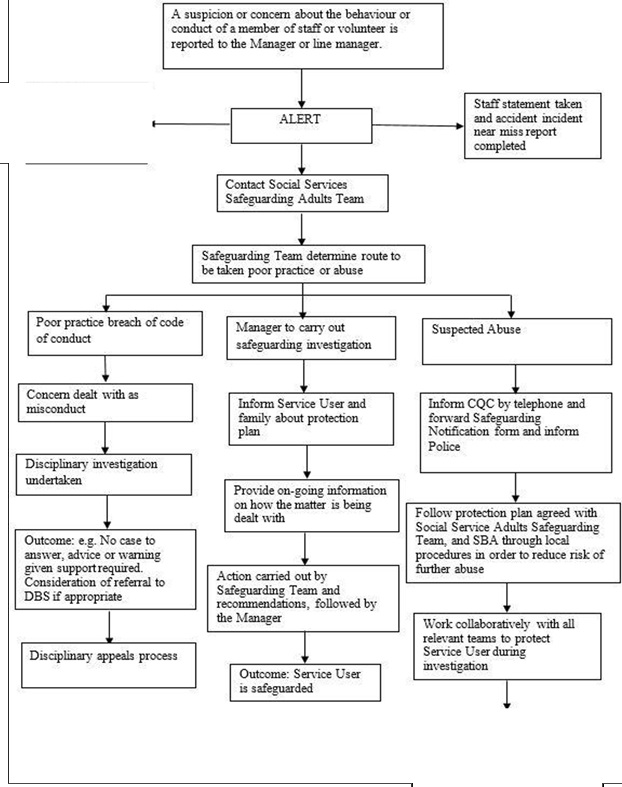
(THIS IS TO PROVIDE INFORMATION TO THE TELE-REHAB DIRECTORS AND ASSOCIATES)
Restrictive and Physical Intervention and Behaviour Management policy
1. Introduction and Legal Framework
• The use of restrictive physical interventions aims to safeguard children and maintain a secure, supportive learning environment. Such interventions shall always comply with ‘Section 93 of the Education and Inspections Act 2006: Power of members of staff to use force’ and relevant government guidance.
• Physical intervention is a serious step and must only be used as a last resort, when a child’s behaviour presents an immediate risk of harm to themselves, others, or property, and only when other de-escalation strategies have failed.
2. Underpinning Principles
• Interventions must be:
• Used only when necessary, proportionate, and reasonable
• For the minimum duration required to address risk
• Never used as a form of punishment, to force compliance, or cause pain/humiliation
• All practice must respect equality and human rights, including the Equality Act 2010 and Article 19 of the UN Convention on the Rights of the Child.
3. Prevention and Environment
• Preventive measures focus on:
• Building positive, trusting relationships
• Individualised support plans
• Regular review of physical and environmental risk factors (e.g., crowded spaces, transitions)
• Staff training in de-escalation and trauma-informed approaches
• Environment adaptations (e.g., sensory adjustments, safe spaces) are routinely reviewed to reduce triggers.
4. Behaviour Management Strategy
• Emphasises preventative and positive behaviour support:
• Early identification of escalating behaviour
• Communication and warning at the child’s level of understanding
• Use of scripts, distraction, offering choices, and reasonable adjustments
• Involvement of pupils and parents/carers in planning and reviewing interventions
5. Physical Intervention Procedures
5.1 When Physical Intervention May Be Used
• Only where there is an imminent risk of significant harm or serious property damage
• Only the minimum force necessary, for the shortest period possible
• Individual behaviour support plans should specify approved strategies for children known to present regular risk
5.2 Approved Techniques
• Only techniques taught in externally validated training may be used
• Restraints which restrict breathing, pain compliance, or prone holds are prohibited
5.3 Recording and Reporting
• Every use of physical intervention is immediately recorded in the designated log with:
• Date, time, place, and duration
• Name of staff and children involved
• Reason for intervention, description of incident and intervention, and outcome
• Details of injury or distress, and any medical treatment given
• Parents/carers notified same day except when unsafe to do so
5.4 Follow-up and Support
• Child and staff debriefs after any incident
• Medical checks as required
• Review of triggers, de-escalation, and support provided before incident
• Learning shared with team in supervision/discussions
6. Responsibilities and Training
• All staff receive training in:
• Preventative approaches, de-escalation, trauma-informed practice
• Safe and approved physical intervention
• Staff competence refreshed at least annually, and on induction
• Leadership ensure policy compliance, review all incidents, and oversee regular evaluation
7. Complaints and Allegations
• Clear, accessible complaints procedures for children and parents
• All allegations of harm reported and investigated according to safeguarding procedures
Procedures: Managing Restrictive Physical Intervention
1. Assessment (prior/planned): Risk assessment for pupils likely to need intervention, with specific triggers, warning signs, preferred strategies, and contact staff identified
2. De-escalation (during incident): Use de-escalation strategies, communication, offer space, and attempt to defuse before any consideration of physical intervention
3. Physical Intervention (if required): Use minimum force, only trained staff, with another adult present if possible
4. Aftercare & Reporting: Undertake post-incident support, record, inform, and review as above
5. Review & Learning: Incident reviews at individual and team level, adjust plans and environment as indicated
This framework is designed to be adapted to your specific environment, with individual risk assessment and behaviour support as the foundation for all planning and intervention. Regular review and staff reflection are integral to embedding continual improvement and reducing restrictive practices as far as possible.
Confirmation of reading this policy
Everyone must comply with this policy. The Registered Manager, Dr Anbananden Soopramanien has overall responsibility for this policy. They will monitor it regularly to make sure it is being adhered to.
If you have any questions or concerns about anything in this policy, do not hesitate to contact Dr Anbananden Soopramanien on:
Tel: 07753846383
Email: anba.soopramanien@trusttelerehab.com
I confirm that I have read and understood this policy.
Name: Signature: Date:
This policy applies to the following people in our organisation All Staff, Contractors, Volunteers, and Service Users
Policy Written by Dr Anbananden Soopramanien
Chief Executive Officer / Director
Date Policy written 9 August 2025
Due for Review 9 August 2026
Who has or can give authority to change policy Board of Directors
Where is this policy kept On the companies shared drive.
Date Reviewer Version Date for Next Review Date of recirculation